Photo Credit: x.com/IFC_IOR
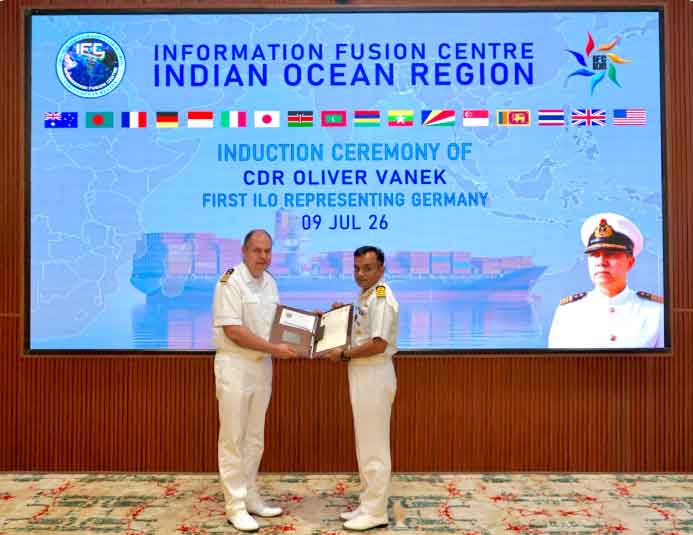
Germany has become the latest country to establish a permanent presence at the Indian Navy’s Information Fusion Centre–Indian Ocean Region (IFC-IOR) in Gurugram, with the induction of its first International Liaison Officer (ILO), marking a significant step in the expanding maritime security partnership between India and Germany.
Commander Oliver Vanek formally joined the IFC-IOR on July 9, becoming the centre’s 17th International Liaison Officer and the first representative from Germany. The induction ceremony was attended by Colonel Klaus Willi Merkel, Defence Attaché of Germany to India.
The development comes at a time when India and Germany are strengthening defence and strategic cooperation across multiple sectors, including maritime security, defence manufacturing, critical technologies and submarine construction.
Germany Joins India’s Maritime Information-Sharing Network
Announcing the development, the IFC-IOR highlighted Germany’s growing role in maritime cooperation in the Indian Ocean Region (IOR).
“Germany’s induction adds the perspective of a key European maritime partner and strengthens IFC-IOR’s collaborative framework for information sharing, maritime domain awareness (MDA) and maritime security cooperation in the Indian Ocean Region,” the Centre said in a statement shared on social media.
The Centre further noted that the appointment “reinforces India-Germany maritime engagement and shared commitment towards a safe, secure and stable IOR.”
According to Indian Navy officials, the presence of a German liaison officer is expected to enhance collaborative monitoring of maritime activity, improve information-sharing mechanisms and support regional maritime security initiatives across the Indian Ocean.
Germany’s induction follows the deployment of Indonesia’s first liaison officer to the centre on July 1, underscoring growing international engagement with India’s maritime security architecture.
IFC-IOR Emerges as Key Regional Security Hub
The IFC-IOR was established by the Indian Navy in December 2018 in Gurugram, Haryana, to strengthen maritime domain awareness and facilitate real-time information exchange among partner countries operating in the Indian Ocean Region.
The facility integrates shipping data from coastal radar chains, satellite systems, maritime agencies and partner countries to create a comprehensive maritime picture across one of the world’s most strategically important waterways.
The centre supports efforts to monitor commercial shipping movements and coordinates responses to a range of maritime threats, including piracy, smuggling, human trafficking, illegal fishing, contraband movement and maritime emergencies.
Over the past seven years, the IFC-IOR has evolved into a major multinational platform for maritime cooperation. While the Centre maintains information-sharing arrangements with 28 partner countries and several international organisations, the deployment of resident liaison officers is viewed as a higher level of operational collaboration and trust.
Working alongside Indian Navy personnel, liaison officers facilitate real-time information exchange, improve coordination during maritime incidents and strengthen collective maritime domain awareness.
Network Expands to 17 Resident Liaison Officers
Germany’s arrival brings the total number of resident liaison officers at the IFC-IOR to 17.
The Centre currently hosts officers from Australia, France, Italy, Japan, Kenya, the Maldives, Mauritius, Singapore, Sri Lanka, Thailand, the United Kingdom, the United States and several other Indian Ocean partner nations.
The steady expansion of the liaison officer network reflects increasing international confidence in India’s role as a maritime security partner and the growing importance of information-sharing in safeguarding critical sea lanes.
The Indian Ocean carries a substantial share of global maritime trade and serves as a vital route for energy supplies, making maritime security cooperation a strategic priority for countries across the Indo-Pacific and beyond.
Indo-German Defence Ties Gain Momentum
Germany’s decision to station a liaison officer at the IFC-IOR comes amid a broader upswing in India-Germany defence and strategic relations.
During German Chancellor Friedrich Merz’s visit to India in January 2026, New Delhi and Berlin signed 19 memorandums of understanding covering areas such as defence cooperation, critical technologies, semiconductors, innovation and green energy. The two governments also reaffirmed their commitment to expanding strategic cooperation.
A key pillar of the evolving defence partnership is the proposed Project-75(I) submarine programme, under which Germany’s Thyssenkrupp Marine Systems is partnering with Mazagon Dock Shipbuilders Limited for the construction of six advanced air-independent propulsion submarines in India.
The project, estimated to be worth between USD 8 billion and USD 10 billion, is expected to involve extensive technology transfer and local manufacturing under India’s defence indigenisation programme.
In April 2026, Defence Minister Rajnath Singh visited the Thyssenkrupp shipyard in Kiel alongside German Federal Minister of Defence Boris Pistorius, further signalling growing defence-industrial engagement between the two countries.
Strategic Significance for the Indo-Pacific
Analysts view Germany’s permanent representation at the IFC-IOR as an important symbolic and operational step in the evolution of India-Germany maritime cooperation.
For India, the move strengthens engagement with a major European maritime power and supports New Delhi’s vision of a free, open, inclusive and rules-based Indo-Pacific. For Germany, the deployment provides a greater operational presence in a region that has become increasingly important to global trade, supply chains and geopolitical stability.
As India continues to expand the IFC-IOR’s international network and Germany deepens its engagement in the Indo-Pacific, the appointment of Commander Oliver Vanek reflects a broader convergence of strategic interests centred on maritime security, regional stability and enhanced defence cooperation.