
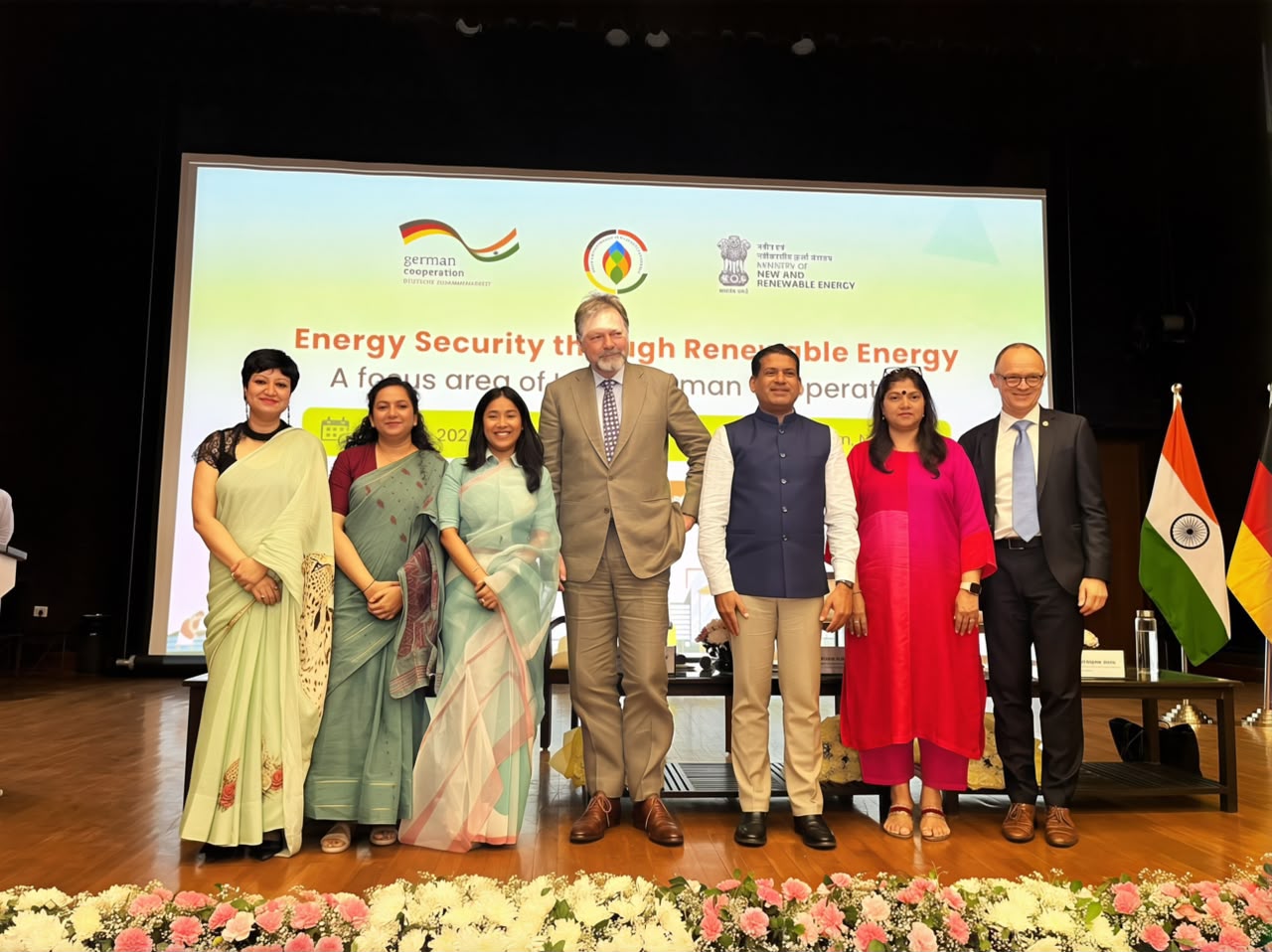
As India and Germany celebrate 75 years of diplomatic relations, the two countries have reaffirmed their commitment to deepening cooperation in renewable energy, underscoring its growing importance for energy security, sustainable development and long-term economic resilience.
The renewed focus on clean energy collaboration was highlighted during the tenth edition of the Indo-German Partnership for Green and Sustainable Development (GSDP) Conversation Series, organised in partnership with the Ministry of New and Renewable Energy (MNRE) in New Delhi on June 18. The discussion, themed “Energy Security through Renewable Energies”, brought together policymakers, industry leaders, think tanks and renewable energy experts to explore how India can accelerate its energy transition while reducing vulnerability to fossil fuel-related price shocks.
Renewable Energy Now a Strategic and Economic Priority
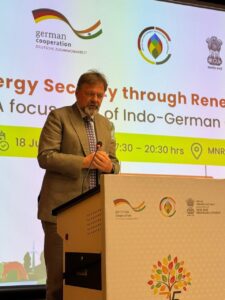 Opening the discussion, Ambassador Dr Philipp Ackermann, German Ambassador to India and Bhutan, said renewable energy has emerged as a strategic necessity that extends beyond climate action.
“Renewable energy is no longer just a climate imperative but also an economic and strategic necessity. India and Germany share a common challenge of reducing dependence on imported fossil fuels and increasing energy independence. Renewables create a powerful ‘trinity’ of climate action, economic opportunity, and energy security,” Amb. Ackermann said.
Highlighting India’s progress in renewable energy deployment, he noted that renewable sources now account for around 26 per cent of the country’s electricity generation.
“The GSDP partnership is particularly significant as India and Germany mark 75 years of diplomatic relations. India and Germany are celebrating 75 years of diplomatic relations. The longstanding bilateral development cooperation has evolved into a partnership addressing climate action and sustainable development for resilient economic growth,” he added.
Amb. Ackermann also highlighted the broad scope of Indo-German cooperation, which spans renewable energy deployment and manufacturing, battery storage, grid integration, energy efficiency, the transition of hard-to-abate sectors, green urban mobility, biodiversity conservation, climate adaptation and mitigation, sustainable urban development and vocational education.
Energy Security in Focus Amid Global Uncertainty
Addressing the event, Santosh Kumar Sarangi, Secretary, Ministry of New and Renewable Energy (MNRE), Government of India, said recent geopolitical developments have reinforced the urgency of strengthening energy security through domestic clean energy deployment.
“The recent crisis in West Asia has once again highlighted the critical importance of energy security. Renewable energy, including solar, wind, battery energy storage systems and green hydrogen – has immense potential to strengthen energy security while supporting sustainable development,” Sarangi said.
He pointed to India’s growing renewable energy capacity and reiterated the government’s commitment to its long-term clean energy targets.
“India has made significant progress, with non-fossil fuel sources now accounting for approximately 54 percent of the country’s installed electricity capacity, and we remain firmly committed to achieving 500 GW of non-fossil fuel capacity by 2030. As trusted partners in the global energy transition, India and Germany can continue to work together to drive innovation, mobilise investment, and advance our shared goals of energy security, sustainable development and climate action,” he said.
Renewable Energy Central to India’s Growth Strategy
India has set an ambitious target of achieving 500 GW of non-fossil fuel electricity capacity by 2030 and reaching net-zero emissions by 2070.
With rapid economic growth driving higher energy demand, ensuring reliable and affordable energy supplies has become a key pillar of national development. Policymakers increasingly view energy security as essential to achieving the vision of Viksit Bharat and supporting India’s aspiration of becoming a USD 30 trillion economy by 2047.
Solar power, wind energy and battery storage technologies are expected to play a central role in reducing dependence on imported fossil fuels while enabling a transition towards a low-carbon economy.
Scaling Up Storage, Grids and Investment
During the discussion, speakers emphasised that the next phase of India’s renewable energy transition must move beyond generation capacity alone and focus on strengthening the broader energy ecosystem.
Participants highlighted the need to accelerate investments in energy storage systems, modernise transmission and distribution networks, improve grid integration, expand domestic manufacturing capabilities, mobilise climate finance and promote the electrification of energy-intensive sectors.
The discussion also underscored the importance of stronger public-private collaboration in ensuring that renewable energy can be deployed at the scale required to support both energy security and sustainable economic growth.
The challenge ahead, participants noted, is not only producing cleaner energy but ensuring that the wider system can efficiently absorb, transmit, finance and utilise renewable power.
Reflecting this challenge, NITI Aayog’s Pathway to Net Zero report, published in February 2026, noted that “The real risk to Net Zero implementation is whether the system can absorb, transmit, finance, and reliably use that cleaner power at scale.”
Germany Remains a Key Partner in India’s Energy Transition
Germany has been one of India’s long-standing partners in advancing the clean energy transition through bilateral development cooperation. Over the years, both countries have collaborated on renewable energy expansion, power-sector reforms, transmission and distribution infrastructure, energy storage, green hydrogen, energy efficiency, climate finance and skills development.
The June 18 discussion also featured contributions from Vaishali Nigam Sinha, Co-founder and Chairperson of Sustainability, ReNew, and Aparna Roy, Fellow and Lead, Climate Change and Energy Programme, Observer Research Foundation (ORF), alongside representatives from government, industry and policy institutions.
Launched in 2022, the Indo-German Partnership for Green and Sustainable Development serves as the flagship framework guiding bilateral cooperation on climate action and sustainable development. The initiative supports progress towards the Sustainable Development Goals and the objectives of the Paris Agreement while promoting climate-resilient and sustainable economic growth.
The discussions highlighted the growing convergence between India and Germany on the role of renewable energy as a driver of economic competitiveness, energy independence and climate resilience. As India accelerates its transition towards a cleaner energy future, cooperation with Germany is expected to remain an important pillar in advancing innovation, investment and the large-scale deployment of renewable energy technologies.