
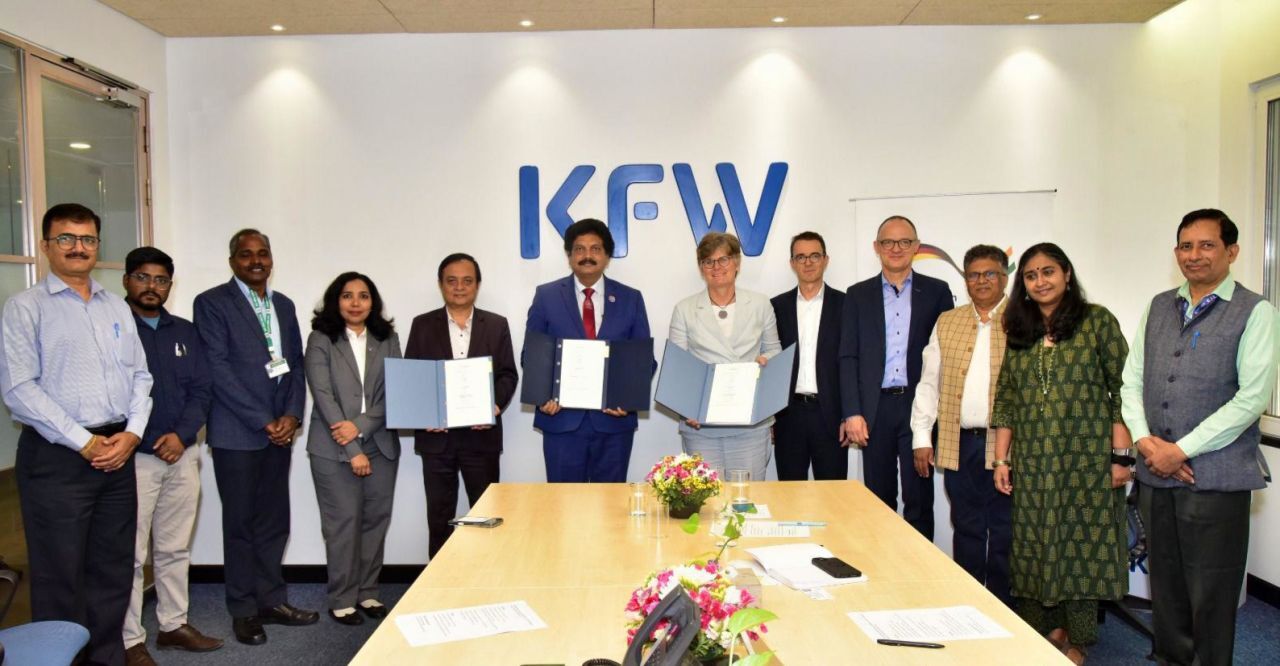
Photo Credit: KfW
State-run NLC India Limited (NLCIL) has secured a €100 million loan from German development bank KfW, in a move aimed at accelerating solar power and battery energy storage system (BESS) deployment in India.
The agreement was signed on April 20, 2026, at KfW’s New Delhi office in the presence of senior officials from both organisations. The funding is expected to support solar generation capacity alongside advanced energy storage systems, enhancing grid reliability and strengthening NLCIL’s renewable portfolio.
“The funding will support solar power generation and battery energy storage systems, strengthening clean energy capacity and grid reliability. It will also enable access to capital at competitive rates and diversify NLCIL’s borrowing portfolio,” the company stated.
Focus on Solar, Storage and Grid Stability
The financing will specifically back solar PV projects and BESS infrastructure, which are increasingly critical for balancing intermittent renewable energy supply.
According to Stefan Kliesch, Head of Energy Team at KfW Office in New Delhi, the partnership reflects a strategic push towards innovative, land-efficient clean energy solutions.
“This week, KfW and NLC India Limited Official signed a €100 million loan agreement to finance a battery energy storage system and solar park project on former mining land in India,” Kliesch said in a LinkedIn post.
“We are proud to support NLC India’s ambitious renewable energy expansion strategy through this innovative, land-efficient approach,” he added.
The loan will finance a 70 MW solar PV project coupled with a 150 MWh BESS installation on reclaimed mining land in Neyveli, along with an additional 500 MWh of battery storage capacity across three sites near Madurai and Tuticorin in Tamil Nadu.
“These BESS installations are expected to play a key role in reducing renewable energy curtailment, enhancing grid stability, and enabling efficient energy storage for deployment during peak demand periods,” Kliesch noted.
Leadership Highlights Growth Trajectory
NLC India Chairman and Managing Director M. Prasanna Kumar outlined the company’s aggressive expansion plans.
He said NLC India began the year with around 1,400 MW of renewable energy capacity, has already added 300 MW, and plans to add another 300 MW.
By the end of the financial year, the company is expected to reach approximately 2 GW capacity, aligning with its long-term target of 10 GW.
He further noted that the company is expanding across multiple states and has formed a joint venture with the Rajasthan government to add 2 GW of renewable energy capacity.
Aligned with 2030 and Net-Zero Goals
The latest funding aligns with NLC India’s broader roadmap to scale renewable capacity to 10 GW by 2030 and increase the green share of its energy portfolio to 50%, contributing to India’s net-zero target by 2070.
The company has also set an interim target of adding around 8 GW of renewable capacity by 2028.
Recent Developments Strengthen Renewable Pipeline
NLC India has been actively expanding its renewable footprint:
- In January 2026, it fully commissioned a 300 MW solar power project in Barsingsar, Rajasthan, under the Union Ministry of New and Renewable Energy’s CPSU scheme.
- The same month, it signed an MoU with the Gujarat government for large-scale solar, wind, hybrid, and BESS projects, representing an estimated investment potential of ₹250 billion.
In December 2025, the company secured its first green loan under the External Commercial Borrowing framework, raising JPY 15.464 billion (approximately $100 million) from Sumitomo Mitsui Banking Corporation (SMBC) to fund renewable energy projects through its subsidiary, NLC India Renewables (NIRL).
Signing Ceremony and Key Participants
The agreement was signed by Carolin Gassner and Frank Bohnet on behalf of KfW. Officials including Rukmini Parthasarathy, Deputy Director at KfW New Delhi, and Ramana Reddy were present, with additional participants joining virtually.
From NLC India, CMD Prasanna Kumar Motupalli and Director (Finance) Prasanna Kumar Acharya attended the ceremony. The agreement was formally executed by Murugan D, DGM (i/c), on behalf of NLCIL, and Padmavathi J, CFO of NIRL, the project executing agency.
Also present was Gottfried von Gemmingen, Head of German Economic and Development Cooperation at the German Embassy in New Delhi.
Repurposing Mining Land for Renewable Growth
Highlighting the broader potential, Kliesch pointed to India’s vast opportunity to repurpose mined land for renewable energy.
“The potential for repurposing abandoned mining land for renewable energy in India is immense: More than 60 coal mines and around 500 km² of land could be suitable for solar deployment—representing an estimated 27 GW of solar PV capacity,” he said.
“We look forward to scaling up similar renewable energy, BESS and land-saving projects together with NLC India Limited.”
Strategic Indo-German Collaboration
The agreement marks another step in deepening India-Germany cooperation in sustainable energy, combining financing, technology, and policy alignment to accelerate the clean energy transition.
With grid stability and storage emerging as key challenges in renewable integration, the NLCIL-KfW partnership underscores a growing emphasis on hybrid energy systems that combine generation with storage—critical for India’s evolving power landscape.