Photos’ Credit: x.com/rajnathsingh
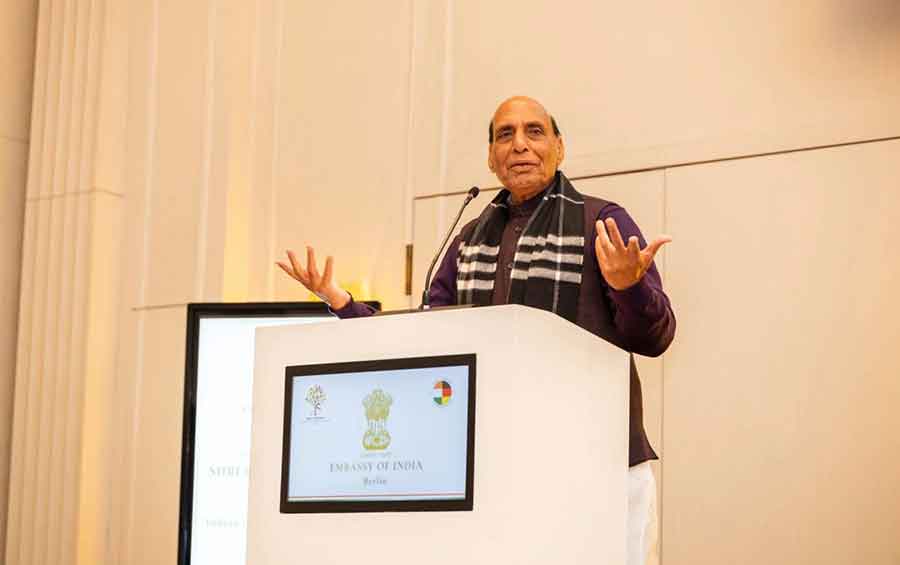
Defence Minister Rajnath Singh on Tuesday, 21st April, underscored the deepening trajectory of India–Germany relations, highlighting their expansion across strategic, economic, and cultural domains during his three-day visit to Germany.
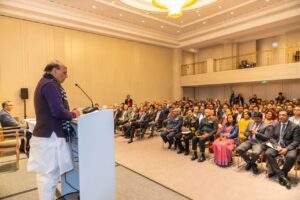 Addressing the Indian diaspora in Berlin, Minister Singh said ties between the two countries have “gradually become stronger with time,” emphasising that the partnership extends beyond politics and defence to shared cultural and artistic engagement.
“This year, the formal diplomatic relations between the two nations, based on democratic values, have completed 75 years,” he noted, adding that Germany remains India’s largest trading partner in Europe, with over 2,000 German companies operating in India.
He also highlighted the role of the Indian diaspora, stating that the 3.7 lakh-strong community in Germany continues to play a vital role in strengthening bilateral ties.
India’s Economic Momentum and Global Positioning
Highlighting India’s economic growth, the Defence Minister said the country is advancing at a growth rate of around 7 per cent, with significant progress in education, skills, research, and innovation.
He pointed out that India has emerged as the world’s third-largest startup and Artificial Intelligence ecosystem and has signed free trade agreements with nearly 38 countries, enabling broader global market access for Indian manufacturers.
“Earlier, India’s words at the international fora were not heeded; but today, the whole world listens carefully,” he said, attributing the shift to India’s rising global stature under Prime Minister Narendra Modi.
Aatmanirbhar Bharat as a Platform for Co-Innovation
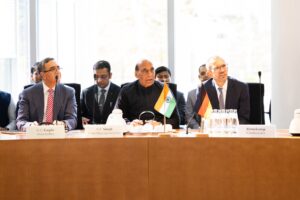 Addressing the German Parliamentary Standing Committee on Defence and Security, Minister Singh made a strong case for enhanced defence industrial collaboration, positioning India’s self-reliance initiative as a collaborative opportunity.
“Aatmanirbhar Bharat is not merely a procurement programme; it is an invitation to co-create, co-develop, and co-innovate,” he said.
He stressed that India’s defence sector is undergoing “unprecedented transformation” and that partnerships with German industry could deliver mutual gains.
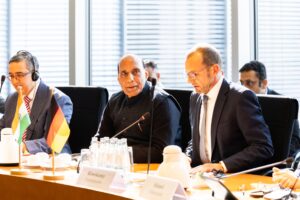 “We recognise the established strengths of Germany’s leading industrial enterprises, while also admiring the vigour and dynamism of the renowned German Mittelstand (small & medium-sized companies) in advanced and emerging technologies. In India too, our start-ups and enterprising private companies are rapidly enhancing and complementing the capabilities of our larger and established defence enterprises. This is an area where India and Germany naturally complement each other, and our partnership can deepen further,” said the Defence Minister.
Shared Strategic Vision and Global Role
Emphasising the need for stronger global cooperation, Minister Singh highlighted alignment between India and Germany at both bilateral and European levels.
“Prime Minister Narendra Modi and German Chancellor Friedrich Merz have placed strong emphasis on advancing this strategic partnership. We also see a clear convergence of views at the European Union level, reflected in the growing momentum to engage with India, including through the India-EU Defence and Strategic Partnership,” he said.
Reiterating the broader significance of the partnership, he added: “We are established democracies bound by shared values, and dynamic economies driven by resilience, innovation, and a determined industrial spirit. As lawmakers and esteemed members of the Committee, your guidance, voice, and support can further strengthen and enrich the future course of our defence and strategic cooperation. When the chronicles of this era are penned, the India-Germany partnership will stand as a paragon of diplomacy, crafted not in response to crisis, but through the steady resolve of two mature democracies choosing to walk this path together.”
Geopolitical Risks and India’s Strategic Response
The Defence Minister also flagged rising global uncertainties, warning that geopolitical instability now carries worldwide consequences.
He noted that such developments are “not localised disturbances, but serious developments with far-reaching implications for energy security, food security, and global economic stability,” alongside humanitarian costs.
Highlighting India’s vulnerabilities, he said: “For a developing country like India, which relies on the West Asian region for a significant share of its energy requirements, disruptions in the Strait of Hormuz are not distant events; they are stark realities with direct implications for our security and economic stability.”
He added that India has adopted a proactive approach, with a Group of Ministers on West Asia continuously assessing the evolving situation.
“Bringing together key ministries, our deliberations focused on safeguarding energy supplies, maintaining the availability of essential commodities, containing inflationary pressures, and protecting citizens as well as industry from external disruptions. This reflects India’s capacity to respond to global crises with calmness, foresight, and effective institutional coordination,” he said.
Parliamentary Engagement and Strategic Dialogue
Minister Singh’s interaction with German lawmakers was hosted by Thomas Roewekamp, Chairman of the Parliamentary Committee, underscoring growing legislative engagement between the two countries.
Cultural Diplomacy: Tribute to Tagore
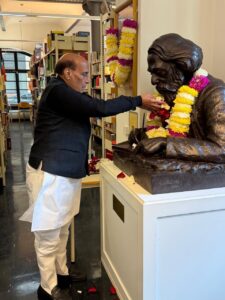 Earlier, the Defence Minister visited Humboldt University of Berlin, where he paid floral tributes to Rabindranath Tagore, highlighting the enduring cultural and intellectual bonds between India and Germany.
Tagore’s early 20th-century engagement with Germany, marked by mutual admiration with German thinkers and artists, played a key role in introducing his work across Europe.
Ceremonial Welcome and Visit Highlights
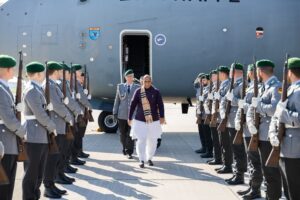 Upon arrival in Berlin, Minister Singh was accorded a ceremonial welcome with military honours. He was flown in a special German Air Force aircraft, escorted by fighter jets during his journey from Munich to Berlin.
The visit signals a renewed push to expand India–Germany cooperation across defence, technology, and strategic sectors, as both countries mark 75 years of diplomatic relations.