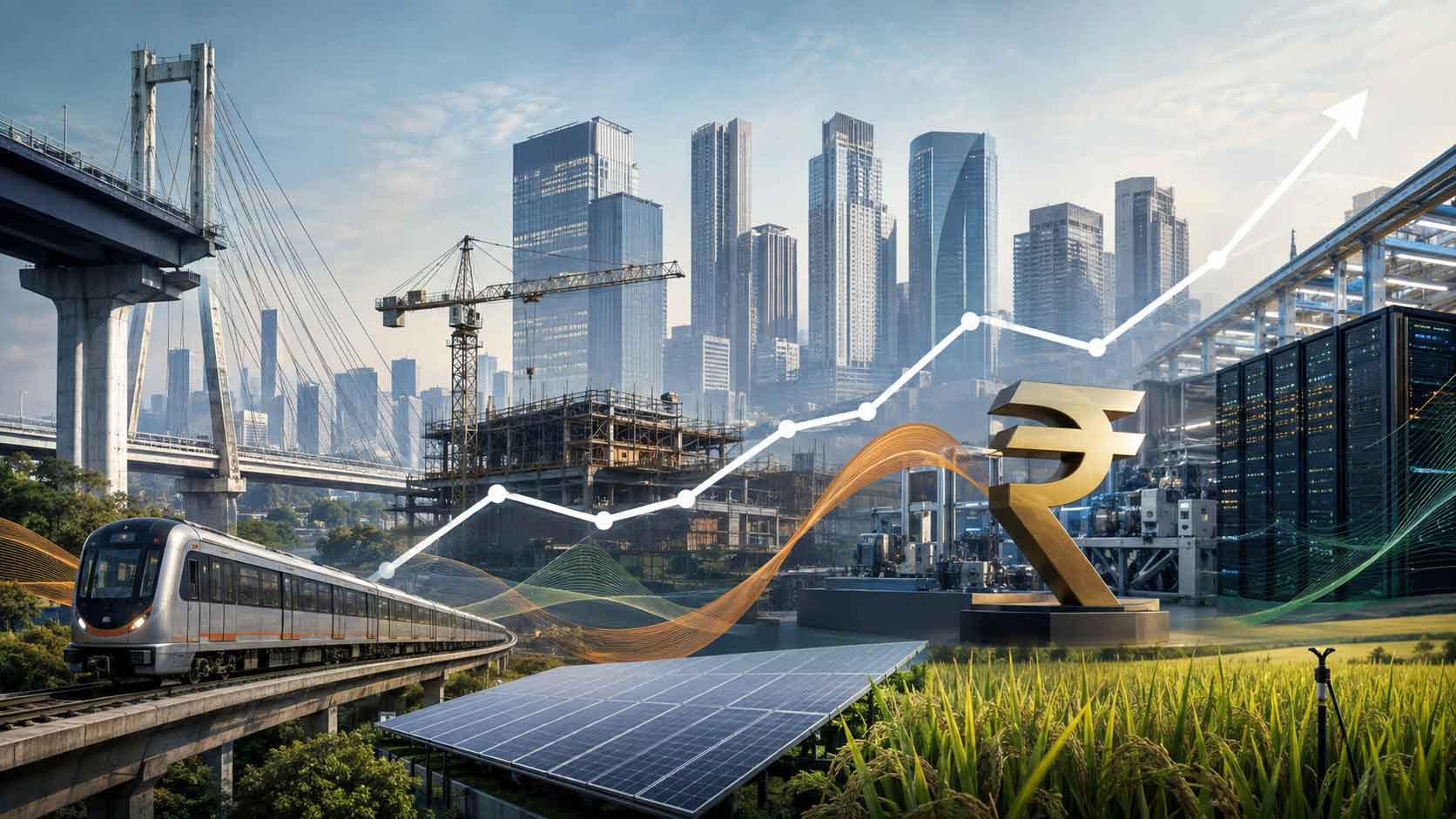
India’s economy grew by 7.8% in the April–June quarter of the 2026–27 financial year, accelerating from 6.9% in the corresponding period a year earlier, according to data released by the Ministry of Statistics and Programme Implementation on August 31.
The growth rate was higher than the Reserve Bank of India’s projection of 7% for the quarter. However, it was lower than the 8.6% growth recorded in the preceding January–March quarter.
The latest figures show that services remained the principal contributor, while manufacturing, construction and investment recorded stronger growth. Agriculture expanded at a slower pace, and mining contracted during the quarter.
Real gross domestic product, which measures output after adjusting for inflation, was estimated at ₹81.36 lakh crore, compared with ₹75.46 lakh crore in the first quarter of FY26.
At current prices, nominal GDP grew by 10.3% to ₹88.27 lakh crore. Nominal growth stood at 8.1% in the corresponding quarter last year.
Services lead growth
The tertiary sector grew by 10% at constant prices, compared with 8% during the same period of FY26.
Financial services, real estate, information technology and professional services recorded growth of 12.1%, up from 8.8% a year earlier. This was the fastest-growing major service category during the quarter.
Trade, hotels, transport, communication, broadcasting-related services and storage expanded by 8.5%. Public administration, defence and other services, which include education, health, recreation and personal services, grew by 7.5%.
Together, the figures show that financial and professional services accounted for much of the acceleration within the services economy.
Manufacturing and construction expand
The secondary sector, comprising manufacturing, utilities and construction, grew by 8.6%, compared with 6.1% in the first quarter of the previous financial year.
Manufacturing expanded by 9.2%, up from 8.3% a year earlier. Electricity, gas, water supply and other utility services grew by 8.9%, reversing the 1.8% contraction recorded in the corresponding quarter of FY26.
Construction grew by 7.7%, compared with 5.2% a year ago.
Several related indicators also recorded an increase during the quarter. Cement production grew by 8.9%, finished steel consumption by 8.3%, and the infrastructure and construction-goods segment of the Index of Industrial Production by 7.2%.
Investment growth outpaces consumption
Gross fixed capital formation, which reflects investment in infrastructure, machinery and other fixed assets, increased by 11.9% at constant prices. This compared with growth of 5.8% during the same quarter last year.
At current prices, the share of gross fixed capital formation in GDP rose from 31.4% to 34.3%.
Private final consumption expenditure, a measure of household spending, grew by 7.1%, marginally higher than the 6.8% recorded a year earlier. Government final consumption expenditure expanded by 4.3%.
Exports of goods and services grew by 12% in real terms, while imports declined by 1.1%.
Agriculture grows; mining contracts
Growth in the primary sector slowed to 2.9% from 5.3% in the corresponding quarter of FY26.
Agriculture, livestock, forestry and fishing expanded by 3.6%, compared with 4.4% a year earlier. Mining and quarrying contracted by 2.4% after recording growth of 12.4% in the same quarter last year.
The slower primary-sector performance contrasted with the faster expansion recorded across services and industry.
Prime Minister Modi calls growth an ‘exemplary’ performance
Responding to the data, Prime Minister Narendra Modi described the 7.8% growth as an “exemplary” performance and a “herculean feat.”
In a post on X, Prime Minister Modi said the collective strength of the Indian people had enabled the economy to record the growth despite oil-price shocks, supply-chain pressures and wider global uncertainty.
“Doomsayers were doomed and India bloomed…yet again!” the Prime Minister wrote.
Union Finance Minister Nirmala Sitharaman also attributed the performance to the efforts of the Indian people and the government’s economic reforms and management.
GDP figures based on revised series
The quarterly estimates have been compiled under India’s revised national accounts series, which uses 2022–23 as its base year. Introduced in February 2026, the new series incorporates updated industrial, producer-price and administrative data.
It also uses a double-deflation method to calculate manufacturing value added. Under this approach, output and intermediate inputs are adjusted separately for price changes.
The government has noted that the estimates may be revised as additional data becomes available.
Overall picture
The first-quarter data presents a mixed but largely expansionary picture of the Indian economy. GDP growth accelerated year-on-year and exceeded the RBI’s projection, although it moderated from the preceding quarter.
Services recorded the highest sectoral growth, manufacturing and construction improved, and fixed investment registered a double-digit increase. At the same time, agricultural growth slowed, mining contracted and government consumption grew at a comparatively moderate pace.
The official GDP estimates for the July–September quarter of FY27 are scheduled to be released on November 30, 2026.