The German Embassy in New Delhi hosted the 11th edition of the Indo-German Partnership for Green and Sustainable Development (GSDP) Conversation Series, bringing together young innovators, policymakers and development practitioners to discuss climate action, clean energy, sustainable cities and gender equality.
Organised to mark the United Nations’ International Youth Day, the session was titled “Young Voices for Sustainable Development”. It examined how young people can contribute to a more sustainable, inclusive and climate-resilient future.
The programme took place against the backdrop of an expanding bilateral development portfolio. During India–Germany development-policy negotiations held in New Delhi in September 2024, Germany made new commitments of more than €1 billion across the GSDP’s core areas. This took cumulative commitments under the partnership to approximately €3.2 billion since its launch in 2022, according to the joint statement issued after the seventh India–Germany Inter-Governmental Consultations. German Federal Foreign Office
Youth dialogue focuses on four Sustainable Development Goals
The Conversation Series centred on four United Nations Sustainable Development Goals: SDG 5 on gender equality, SDG 7 on affordable and clean energy, SDG 11 on sustainable cities and communities, and SDG 13 on climate action.
Participants examined the involvement of young people in developing clean-energy solutions, promoting inclusive urbanisation and sustainable mobility, advancing gender equality and responding to climate-related challenges.
The session also considered how bilateral partnerships could support the next generation in converting ideas into practical interventions.
Georg Enzweiler highlights role of young people
Opening the event, Georg Enzweiler, Chargé d’Affaires at the Embassy of the Federal Republic of Germany in New Delhi, emphasised that contemporary global challenges required cooperation among governments, businesses, scientists, entrepreneurs and communities.
Mr Enzweiler said young people should not be regarded solely as future leaders because they were already developing solutions, driving innovation and encouraging institutions to reconsider established approaches to sustainability, climate justice and inclusion.
He added that the GSDP was founded on the understanding that lasting change depended on partnerships, with young people serving as essential participants in that process.
Interactive discussion examines youth-led solutions
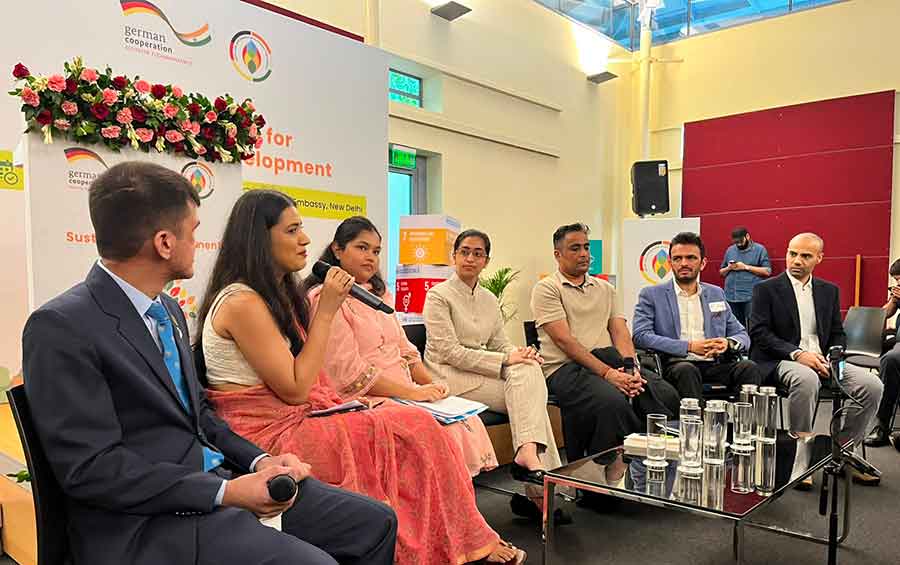
A key component of the programme was a fishbowl discussion, an interactive format designed to facilitate participation by both speakers and members of the audience.
The discussion was moderated by Jasmine Kaur, Officer in the Economic Cooperation and Development Division of the German Embassy.
The panel comprised Prateek Khandelwal, Founder of RampMyCity; Dr Priyanshi Chauhan, Energy Advisor at GIZ India; Ronak Jogeshwar, Senior Fellow with the Viksit Bharat Program; and Pallavi Agrawal, Programme Analyst at UN Women India.
The panellists discussed sustainable urban development, clean-energy access, gender equality and climate action. They also examined how youth-led innovation, entrepreneurship and collaboration could help translate the Sustainable Development Goals into practical projects.
Exhibition showcases young changemakers
An accompanying exhibition presented initiatives developed by young changemakers from different parts of India.
The exhibits covered inclusive and sustainable public transport, urban development, clean energy, climate action and gender equality. They also highlighted interventions undertaken through Indo-German cooperation projects.
The exhibition sought to recognise the contributions of emerging innovators and encourage wider youth participation in sustainable-development programmes.
More than €1 billion committed across GSDP sectors
The India–Germany development-policy negotiations in September 2024 were led by India’s Department of Economic Affairs under the Ministry of Finance and Germany’s Federal Ministry for Economic Cooperation and Development.
Germany committed more than €1 billion through concessional loans and technical cooperation. The funding covered renewable energy, transmission and distribution infrastructure, urban development, sustainable mobility, forest ecosystems, water management, climate-resilient agriculture, agroecology, vocational education and cooperation with the National Mission for Clean Ganga.
The two countries also agreed to continue cooperation in renewable energy, urban development, mobility and agroecology.
Barbara Schäfer, who headed the German delegation during the negotiations, described the relationship as a longstanding and strategically important partnership built on mutual trust. She said the bilateral developments recorded in 2024 demonstrated the strength of that cooperation.
Ms Schäfer identified the launch of the India–Germany Platform for Investments in Renewable Energy Worldwide as an important step in taking the partnership forward. The platform was launched at the fourth RE-INVEST conference in Gandhinagar on September 16, 2024.
She said Germany’s commitments demonstrated that it was meeting its international responsibilities, while stressing that the partnership also needed to produce concrete results.
Transmission and urban-mobility projects highlighted
Among the outcomes cited during the 2024 negotiations was the development of approximately 7,700 kilometres of modern electricity-transmission infrastructure through Indo-German cooperation.
German development financing has also contributed to metro projects in Mumbai, Surat and Ahmedabad, along with the Water Metro in Kochi. The German Federal Ministry for Economic Cooperation and Development has separately reported that green-energy corridors supported through the partnership provide renewable electricity to around 40 million people.
Ms Schäfer said Germany was also assisting Indian farmers in making agricultural production more climate-resilient, resource-efficient and sustainable. She added that India and Germany were applying their respective expertise through triangular cooperation projects in Peru and several African countries.
Uwe Gehlen, Head of German Development Cooperation in India and Minister Counsellor at the German Embassy, said the combination of Indian and German capabilities gave the sustainable-energy transition greater significance. He added that such cooperation could provide an example both within the two countries and internationally.
Pamela Baijal underscores youth role in bilateral cooperation
Pamela Baijal, Deputy Head of the Economic Cooperation and Development Division at the German Embassy, delivered the vote of thanks at the conclusion of the youth dialogue.
Ms Baijal thanked the speakers, exhibitors and participants for their contributions. She also reiterated the importance of including young voices in India–Germany cooperation on sustainable development.
GSDP established in 2022
Prime Minister Narendra Modi and then German Chancellor Olaf Scholz established the Green and Sustainable Development Partnership on May 2, 2022.
The GSDP serves as the principal bilateral framework for cooperation on sustainable and climate-aligned development. It supports initiatives contributing to the United Nations Sustainable Development Goals and implementation of the Paris Agreement.
Its areas of cooperation include renewable energy, grid integration, green hydrogen, energy storage, sustainable urban development, green mobility, climate-resilient agriculture, natural-resource management and the economic participation of women. Germany has committed to supporting India with at least €10 billion under the partnership until 2030, largely through concessional financing.