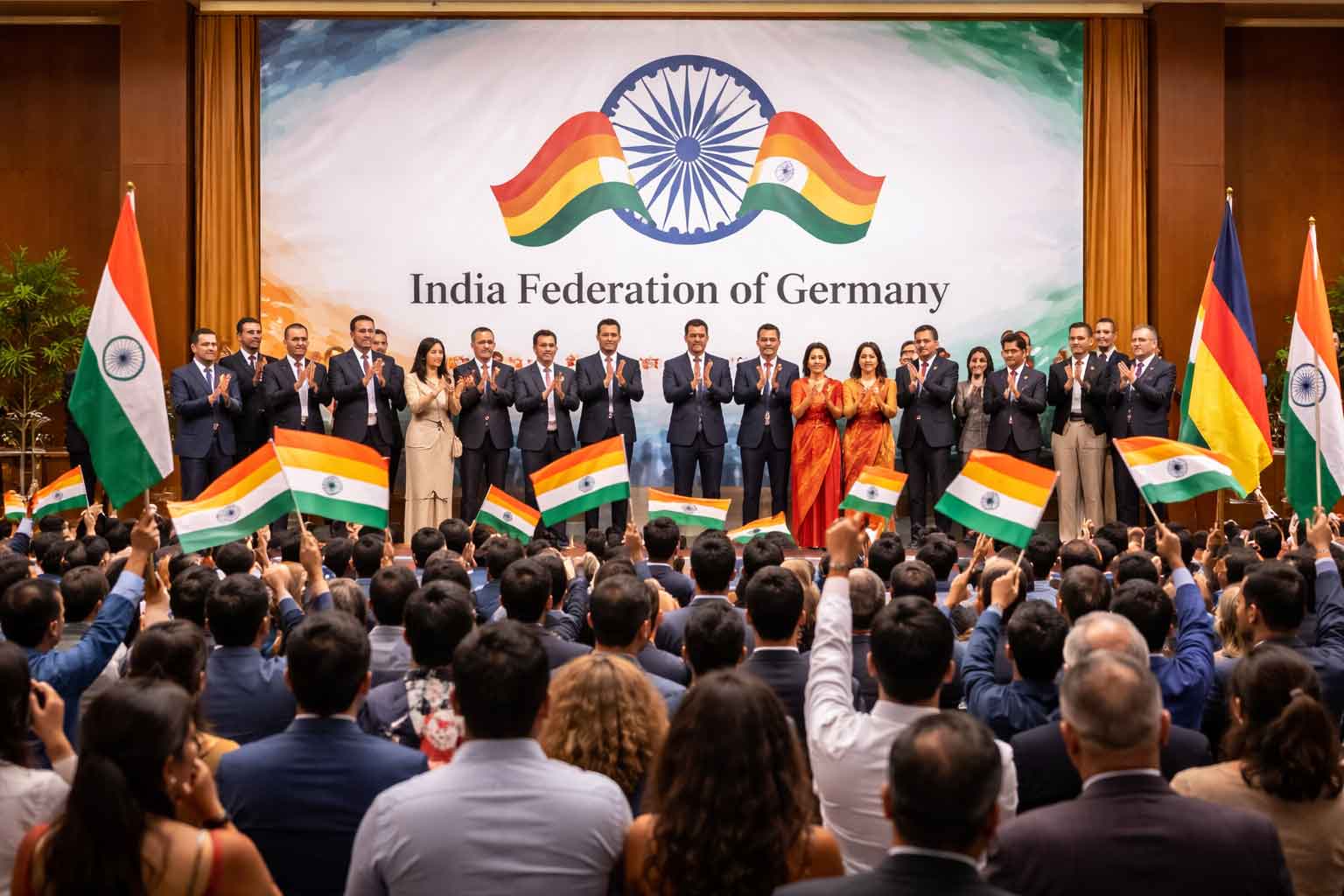
Representative Photo
In a significant step for the Indian diaspora in Germany, the Bundesverband der Indischen Vereinigungen e.V., also known as the India Federation of Germany (IFG), was officially registered on Friday, March 27, 2026, as the country’s national umbrella organisation representing people of Indian origin.
The registration marks the first time that over 100 Indian associations across all 16 federal states have come together under a single, coordinated platform—signalling a new phase in diaspora engagement and India–Germany relations.
A unified voice for a growing diaspora
With an estimated 300,000 people of Indian origin living in Germany, the IFG aims to act as a central representative body, facilitating structured engagement with German institutions, policymakers, and civil society.
Community leaders say the move addresses long-standing fragmentation within the diaspora, bringing together diverse regional and professional associations under one umbrella.
“The founding of the IFG is not simply the birth of a new organisation—it is the recognition of a historic necessity,” said Siddharth (Sid) Mudgal, President of IFG.
“The Indian Diaspora in Germany are 300,000 strong, deeply embedded in German science, technology, business, and society. For too long, the 100-plus associations have worked in fragmentation. The IFG is a permanent bridge between India and Germany, built by this community, for this community, and in service of both nations.”
Strengthening India–Germany ties
The formation of IFG comes at a time when bilateral relations between India and Germany are gaining renewed momentum across trade, technology, clean energy, and talent mobility.
Observers note that the timing aligns with German Chancellor Friedrich Merz’s recent visit to India, which underscored the growing strategic importance of the partnership.
Positioning itself as a “living bridge” between the two nations, IFG aims to contribute to this evolving relationship by leveraging the diaspora’s economic and intellectual capital—estimated to contribute nearly €15 billion annually to Germany’s economy.
Federal structure to drive grassroots engagement
The IFG has adopted a federal structure, with regional chapters across all 16 German states, beginning with key hubs such as Baden-Württemberg, Bavaria, Berlin, Hessen, and Hamburg.
According to the organisation, this decentralised model ensures local representation while maintaining a strong national voice.
“The federal architecture of the IFG is its greatest strength,” said Vice-Presidents Gaurav Kumar Tomar and Dhaval Modha.
“Every regional chapter has its own elected leadership and engages directly with organizations and institutional actors locally. The Bundesverband adds national reach and the credibility that only a unified body can provide—before the Bundestag, federal ministries, and the Embassy of India. Together, we are heard nationally.”
Key priorities: Policy, talent, and partnerships
The newly formed federation has outlined four core focus areas:
- Policy advocacy to represent diaspora interests before German institutions
- Building a Germany–India talent bridge to facilitate skills and mobility
- Creating a unified national network of Indian associations
- Advancing partnership diplomacy to strengthen bilateral ties
Through these priorities, IFG aims to enhance coordination among diaspora groups, improve representation, and deepen engagement with stakeholders in both countries.
A platform for representation and integration
Following its official registration on March 27, 2026, IFG is expected to play a broader role in promoting cultural exchange, economic cooperation, and social integration within Germany.
Community leaders have welcomed the initiative, noting that a centralised platform will streamline communication, address shared challenges more effectively, and amplify the voice of Indians living in Germany.
With its formal registration now complete, the organisation is set to begin outreach efforts and expand its membership base, positioning itself as a key national interlocutor for the Indian diaspora.
As India–Germany ties enter a new strategic phase, IFG’s emergence reflects a parallel consolidation within the diaspora—one that seeks to transform community presence into coordinated influence on both sides of the partnership.