

Photos’ Courtesy:
As global supply chains undergo a structural reset, a recent analysis by the Observer Research Foundation (ORF) has called for a fundamental redesign of the India–EU semiconductor partnership—placing industrial impact, rather than intent, at the centre of cooperation. The assessment, presented in the report Redesigning the India–EU Semiconductor Partnership for Industrial Impact, comes alongside a series of high-level India–Germany engagements in March 2026, signalling growing convergence between policy thinking and on-ground industrial collaboration.
ORF flags need for “industrial impact” in India–EU semiconductor ties
In its expert commentary, ORF argues that despite shared ambitions, India and the European Union have yet to translate semiconductor cooperation into meaningful industrial outcomes. The report underscores that “the partnership must move beyond declarations and focus on building manufacturing capabilities, resilient supply chains, and co-investment frameworks.”
The analysis notes that both India and the EU face similar strategic vulnerabilities—particularly overdependence on concentrated semiconductor supply chains—and therefore have a strong case for collaboration. However, it stresses that “without aligning industrial policies, financing tools, and private-sector participation, the partnership risks under-delivering.”
Importantly, the report highlights Germany’s potential role as a key industrial anchor within the EU for such collaboration, given its advanced manufacturing ecosystem and strong Mittelstand base. It further points to complementarities between India’s policy push to develop semiconductor capabilities and Germany’s strengths in precision engineering, industrial equipment, and supply chain integration—making bilateral cooperation critical to the broader India–EU framework.
Germany emerges as a critical partner in India’s semiconductor ambitions
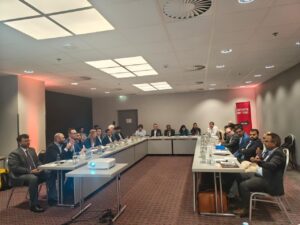 This policy perspective is increasingly reflected in real-world engagements. On 27 March 2026, the Consulate General of India Munich, in collaboration with the Make in India Mittelstand Programme, hosted an investment promotion event titled “India’s Industrial Acceleration 2026 – Sunrise Sectors and The German Opportunity.”
The event brought together over 25 German companies and industry associations, focusing on high-growth sectors including semiconductors, green hydrogen, battery storage, and solar energy.
In his opening remarks, Consul General Shatruganha Sinha emphasised India’s push to align policy incentives with global industrial partnerships. Experts from organizations such as VDMA, EAC International Consulting, European Institute for Future Generations, and Rödl & Partner highlighted both the opportunities and structural challenges in scaling Indo-German collaboration in advanced manufacturing.
Discussions at the event echoed ORF’s core argument—pointing to the need for targeted strategies, policy clarity, and stronger industrial linkages to unlock semiconductor cooperation.
Berlin platform reinforces momentum in India–Germany B2B ties
 Earlier, on 19 March 2026, the Embassy of India Berlin hosted the 9th Make in India Mittelstand Exchange Platform, further reinforcing the growing economic alignment between the two countries.
Delivering the keynote, Thomas Steffen, State Secretary at Germany’s Federal Ministry for Economic Affairs and Energy, encouraged German companies to expand their footprint in India, particularly in emerging industrial sectors.
India’s Ambassador to Germany, Ajit Gupte, highlighted India’s strong economic growth trajectory and emphasised opportunities to deepen cooperation in business, technology, and innovation.
Industry bodies such as BVMW and German Chambers of Commerce Abroad pointed to the “growing momentum” in bilateral B2B ties, with discussions focusing on resilient supply chains and success stories of German companies operating in India.
Bridging policy vision and industrial execution
Taken together, the ORF analysis and recent India–Germany engagements point to a critical inflection point in India–EU semiconductor cooperation.
While policy frameworks are evolving, the emphasis is now shifting toward execution—aligning incentives, mobilising private capital, and building cross-border industrial ecosystems.
As ORF notes, the success of the India–EU semiconductor partnership will ultimately depend on its ability to deliver “tangible industrial outcomes.” Germany’s deepening engagement with India suggests that this transition—from strategy to scale—may already be underway.
Read the original ORF report here.