Germany’s foreign policy reset, known as the Zeitenwende, has elevated India from a largely economic partner to a central pillar of Berlin’s security, technology, trade and demographic strategy, according to a new report by the Observer Research Foundation (ORF) authored by strategic affairs expert Shairee Malhotra.
The report argues that the transformation reflects both Germany’s internal policy shifts following Russia’s war in Ukraine and the growing geopolitical and economic weight of India in an increasingly fragmented global order.
‘Alles klar, Alles gut’: A Partnership Recast
The changing tone of the relationship was symbolically captured during former German Chancellor Olaf Scholz’s visit to India in November 2024, when Prime Minister Narendra Modi described bilateral ties with the phrase, “Alles klar, Alles gut.”
The ORF report notes that this expression “perhaps remains the most accurate characterisation of the current state of the India-Germany strategic partnership,” which was formally established in 2000.
During Scholz’s tenure, Berlin released a “Focus on India” policy paper acknowledging India’s growing international influence and outlining an expanded engagement agenda. His successor, Chancellor Friedrich Merz, has gone further by making India his first Asian destination after taking office in May 2025.
Under the framework of the 8th Intergovernmental Consultations, the two sides signed 19 memorandums of understanding covering defence, green energy, technology, education and people-to-people ties, signalling a broad deepening of cooperation.
Security and Defence Move to the Fore
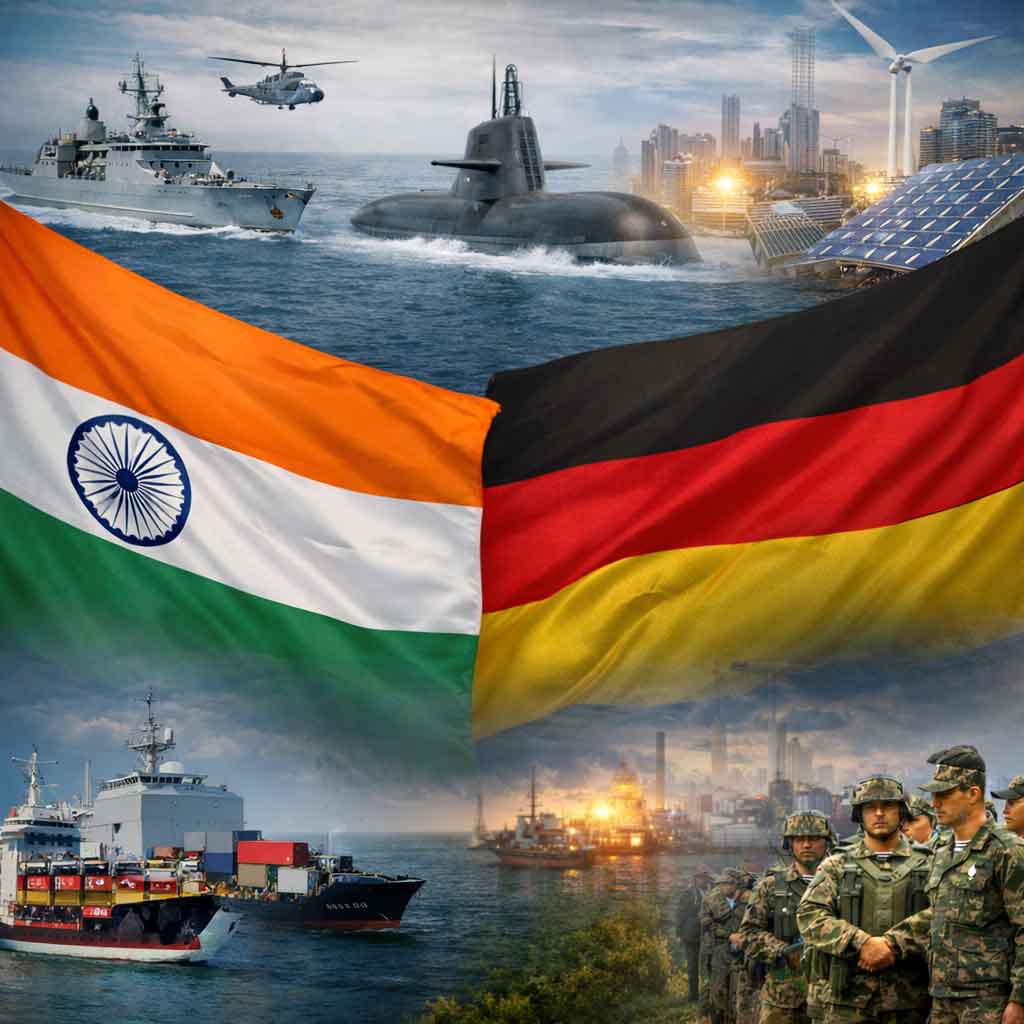
While economic ties remain foundational, the ORF report identifies security and defence as the most significant new driver of the partnership.
Germany’s Zeitenwende following Russia’s invasion of Ukraine led to a relaxation of its traditionally strict arms-export regulations. Combined with India’s recent easing of rules for foreign defence manufacturers, this has accelerated military-industrial cooperation.
A key development is the €8-billion submarine co-production agreement between Germany’s Thyssenkrupp Maritime Systems and India’s Mazagon Dock Shipbuilders Limited. The report describes the deal as India’s largest Make in India defence initiative, designed to advance defence modernisation, promote indigenisation and enable high-end technology transfer.
For Berlin, the project offers access to India’s expanding defence market and supports efforts to reduce New Delhi’s reliance on Russian military equipment. It could also help strengthen Germany’s domestic defence industry, as submarine construction in India would be cheaper than in Europe. TKMS has indicated that India could emerge as a global manufacturing hub for submarines.
The bilateral 37-point Joint Statement commits both governments to strengthen defence ties through a “roadmap for long-term co-development and co-production of military platforms.”
The report adds that in the first half of 2024, India became the third-largest recipient of German arms exports, underscoring the speed of this shift.
Beyond Weapons: Indo-Pacific Security Cooperation
Defence ties are expanding beyond industrial projects. Germany has increased its military presence in the Indo-Pacific, including the 2024 port call of the frigate Baden-Württemberg in Goa.
Other initiatives include:
- joint military exercises such as TARANG SHAKTI and MILAN,
- a bilateral logistics support agreement, and
- the posting of a German liaison officer at India’s Information Fusion Centre – Indian Ocean Region (IFC-IOR).
The report notes that both countries increasingly view each other as essential partners in stabilising the Indo-Pacific — a region critical to global trade routes and increasingly affected by China’s assertive posture.
As Berlin becomes a more prominent security partner for New Delhi, the report concludes that this evolving dynamic is reshaping Indo-German relations into a more explicitly strategic partnership.
Trade and Technology: Diversifying Beyond China
Germany remains the European Union’s largest economy and India’s biggest trading partner within the bloc, accounting for roughly 25 percent of India’s total trade with the EU.
German companies are pushing for the early conclusion of the long-pending EU-India Free Trade Agreement, which is expected to feature prominently at the upcoming EU-India Summit in New Delhi.
For decades, China has dominated German economic engagement in Asia. However, rising EU-China trade tensions, concerns over unfair Chinese trade practices and widening trade deficits have prompted Berlin to seek diversification.
The ORF report highlights that Germany narrowly avoided a third consecutive year of recession, making alternative growth markets more attractive. India’s rise as a manufacturing and business hub has therefore gained strategic importance.
Still, the scale gap remains wide: Indo-German trade stood at about US$50 billion in 2024, compared with US$275 billion in Sino-German trade during the same period. Merz’s forthcoming visit to China is expected to clarify whether Berlin will attempt to rebalance these relationships or align more closely with broader EU positions.
Critical Technologies and Green Cooperation
Technology cooperation is emerging as another cornerstone.
During Merz’s India visit, both sides signed joint declarations covering:
- semiconductors,
- critical minerals,
- telecommunications, and
- digitalisation.
These initiatives aim to enhance economic resilience and technological sovereignty.
Germany has also expanded its commitments under the Green and Sustainable Development Partnership, earmarking €5 billion of its €10-billion pledge for sustainable development projects in India, alongside a detailed green hydrogen roadmap.
The second leg of Merz’s visit took him to Bengaluru, India’s technology hub, where German firms have invested heavily in clean energy, engineering and advanced manufacturing.
Demographic Convergence and Mobility
The report identifies migration as a major area of convergence.
Germany’s ageing population has created a need for around 400,000 skilled foreign workers each year. The Migration and Mobility Partnership Agreement (MMPA) signed in 2022 increased the annual quota for Indian workers from 20,000 to 90,000 visas.
Following Merz’s visit, Germany will introduce visa-free transit for Indian citizens and expand legal skilled migration under the MMPA framework. A Global Skills Partnership, particularly in healthcare, is also planned.
At the same time, the report cautions that domestic opposition to immigration — fuelled by the rise of far-right political forces — will remain a key political challenge for the German leadership.
The Indian diaspora in Germany now numbers around 300,000, largely comprising IT professionals, healthcare workers, researchers and students.
Education and Knowledge Links
Education forms another pillar of long-term cooperation.
An Indo-German roadmap on higher education is being prepared, and Indian students already represent the largest group of international students in Germany, numbering about 60,000.
This figure is expected to rise as traditional destinations such as the United States adopt more restrictive policies toward foreign students.
A Strategic Alignment in an Unstable World
The ORF report concludes that structural complementarities underpin the deepening partnership.
India is the world’s fastest-growing major economy and is projected to surpass Germany as the third-largest global economy. Germany, in turn, is seen as a critical partner in India’s industrial transformation due to its advanced technological capabilities.
The report notes that aligning:
- Germany’s technological strength with India’s modernisation drive,
- Germany’s demographic shortfall with India’s demographic surplus, and
- Germany’s outreach to the Global South with India’s leadership role within it
- creates a clear win-win proposition.
Germany’s domestic policy changes — including reforms to its constitutional debt brake and potential defence spending of 3.5 percent of GDP — could further consolidate its position as a cornerstone of European security.
Externally, shifting global dynamics, including uncertainty in transatlantic relations and disruptions following US President Donald Trump’s second term, have increased the strategic value of EU-India ties. Within this context, the report argues, a consolidated Indo-German partnership could become a stabilising anchor for Europe’s engagement with India and the wider Indo-Pacific.
Source: Observer Research Foundation (ORF). Read the full report here.